


I have replaced my lawn with mostly native Utah plants
I have replaced my lawn with mostly native Utah plants
Hi, everyone - I have replaced my lawn in my front yard with mostly native Utah plants and a few drought tolerant non-invasive perennials. I have a spot where I'm looking to add a low-growing ground cover, kind of to give the eye a rest. It does not have to be tolerant of foot traffic, nor does it need to look like a lawn.
I would love to put in a native plant in this spot, but I'm not sure what would fit the bill. Anyone have a good suggestion?
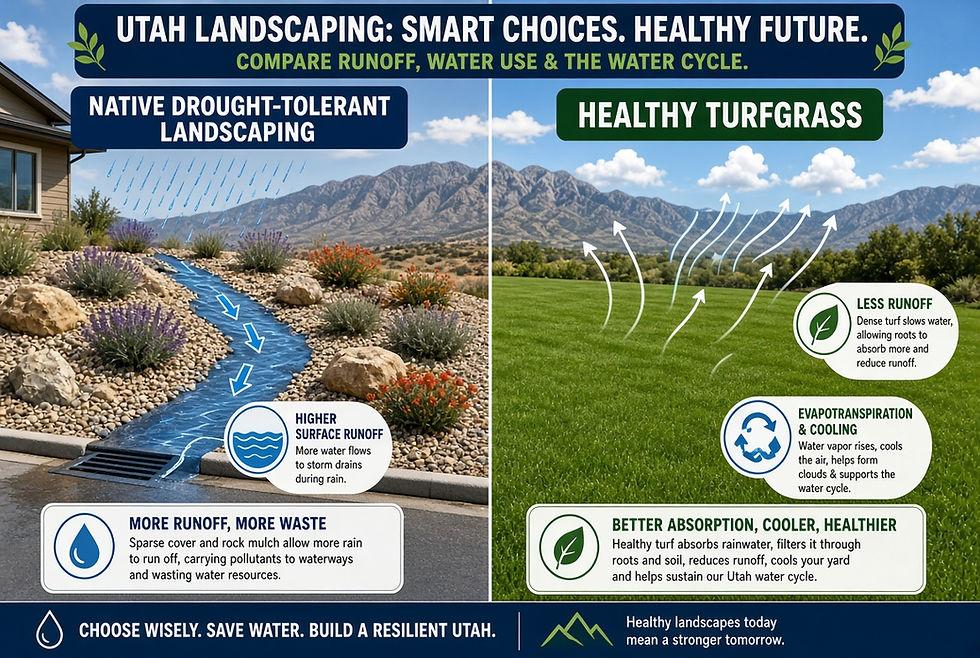
This type of landscaping (mostly Utah native plants + drought-tolerant perennials, with low-growing ground covers) generally reduces the local water cycle’s intensity compared to healthy turfgrass.
Here’s a clear breakdown of what it does:
Positive effects on the water cycle
Lower irrigation demand: Native and drought-tolerant plants are adapted to Utah’s arid climate. Once established, they typically need far less supplemental water than a traditional lawn. This conserves treated municipal or secondary water.
Better soil health potential: Many natives develop deeper root systems over time. Combined with organic mulch or living ground covers, this can improve infiltration, reduce surface runoff, and help retain moisture in the soil rather than letting it sheet off.
Less chemical runoff: Lower fertilizer and pesticide use (common with natives) means cleaner water returning to the system if any runoff occurs.
Habitat and biodiversity: Supports pollinators and local wildlife, which is an ecological plus, though this is more about ecosystem function than the water cycle itself.
Limitations / reduced contribution to the water cycle
Much lower evapotranspiration (ET): Dense, actively growing turfgrass acts like a living water pump — it pulls water from the soil and releases large amounts of vapor into the air (often 70–90% of applied water within 24–48 hours). This rapid recycling increases local humidity, supports cloud formation, and can enhance downwind precipitation (“Grow the Flow” effect). Most Utah natives and sparse drought-tolerant plantings transpire far less water because they are adapted to conserve moisture. The result is weaker local atmospheric moisture recycling.
Less continuous canopy and cooling: A full lawn provides uniform green cover that cools the surface through ET (often 3–15°F cooler). Native plantings with open space, rock, or mulch create more heat islands at the micro scale, reducing the cooling that helps stabilize local climate and moisture patterns.
More bare or mulched soil: Gaps between plants increase soil-surface evaporation (which does not contribute to plant-driven atmospheric moisture the same way) and can raise the chance of runoff during intense storms if the soil is not well covered.
Slower overall moisture turnover: Water that does enter the system stays in the ground longer or is used more sparingly by the plants. It is less likely to cycle rapidly back into the atmosphere multiple times per year the way it does under actively managed grass.
Bottom line for the water cycle
This style of landscaping is excellent for reducing water use (a conservation benefit), but it is weaker at recycling water through the atmosphere and supporting local precipitation and cooling compared with a healthy, properly irrigated turf lawn.
In Utah’s semi-arid climate, the trade-off is real: you save irrigation water, but you also reduce the “living pump” effect that dense vegetation provides for the small water cycle.
If the goal is maximum water conservation and native habitat, this approach is strong. If the goal is maximizing local moisture recycling, atmospheric humidity, cooling, and precipitation support, dense, well-managed grass performs better on those specific metrics.


Comments