


A Real Water Strategy for Utah
A Real Water Strategy for Utah: Protect What Works, Fix What Leaks
Utah's water conversation keeps circling back to the same two knee jerk targets — lawns and farms — as if reducing either one is the whole answer or even part of the answer. It isn't. The water saved by replacing grass amounts to a minor error in tha actual calculation. Both grass and agriculture play essential, irreplaceable roles, and the real water saving opportunities are being missed almost entirely: manaed dormancy, recovering water that never reaches a plant, a home, or the Great Salt Lake at all, because it's lost in transport before it gets there and increasing the water captured for use in the spring runoff, a plan with a payback. Below is A Real Water Strategy for Utah: Protect What Works, Fix What Leaks

Grass is doing real work in Utah's cities
Living grass in urban and suburban Utah is not decoration. It is functioning infrastructure, and it does several jobs simultaneously that nothing else in the urban built environment replaces:
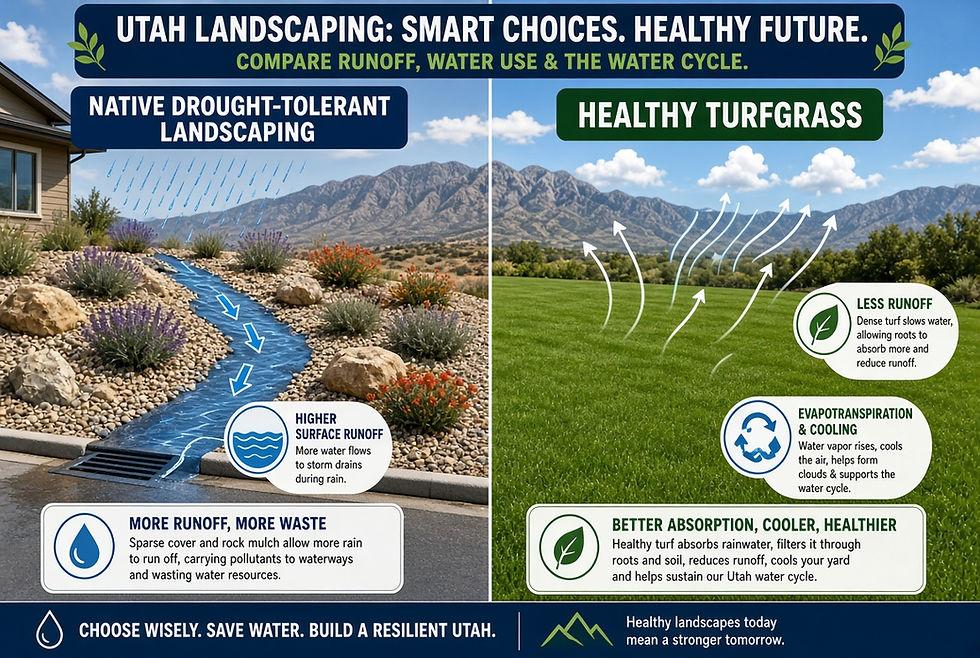
It cools neighborhoods. Living grass measurably lowers surface and near-surface air temperature compared to pavement or bare ground, directly countering the urban heat island effect in the places most exposed to it.
It cycles water back to the atmosphere quickly, over and over. Through evapotranspiration, grass returns water to the atmosphere on a timescale of days to weeks — peer-reviewed research on vegetation water transit times found grass cover can turn its stored water over in under a single day, the fastest of any vegetation type measured. Across a full growing season, that means the same water effectively cycles through a healthy lawn many times, doing cooling and humidity work repeatedly rather than once — compared to water that bypasses the root zone and enters an aquifer or terminal lake, where it can sit for years to centuries before re-entering active circulation.
It filters what runs across it. Grass root systems and soil biology trap sediment and filter out pollutants and impurities carried in runoff, so water that crosses a healthy lawn on its way into the storm drain or the soil arrives cleaner than water that flows straight off pavement.
It protects people. A grass strip is a far softer landing than rock or concrete for kids on bikes, pets, and anyone who trips.
It holds soil in place, sequestering carbon and slowing water long enough to soak into the ground instead of rushing off pavement into storm drains.
It supports public health. A meta-analysis of 18 studies covering more than 3.1 million people found a 10% increase in nearby green space is associated with a 3-3.7% reduction in depression risk.
None of these functions pause when grass looks "unused." Removing it doesn't create a blank, neutral space — it removes cooling, safety, and soil function from exactly the places that need them most, and most often replaces them with gravel that runs measurably hotter than the lawn it replaced.
Agriculture is not the enemy — it's the food supply
Farming uses roughly 75% of Utah's diverted water, and that number gets treated as an indictment rather than what it actually is: the water cost of feeding people. Alfalfa is an easy target because humans don't eat hay directly, but the cattle that produce Utah's beef and dairy do — cutting that water use doesn't just cut a crop, it cuts a food supply chain. Irrigation water isn't destroyed either: some is taken up by crops, some recharges groundwater, some returns to rivers and reservoirs. Farmers have also made real, measurable efficiency gains over the past several decades. Treating agriculture as the villain in the drought conversation misses both the scale of what it produces and the progress already being made.
The right emergency tool: Managed Dormancy, not removal
When water gets genuinely scarce, the answer for urban grass isn't to tear it out — it's to let it do what Kentucky bluegrass, the grass in most Utah lawns, already knows how to do: go dormant. The blades brown and stop growing, but the crown and root system survive underground, ready to green back up within two to three weeks once regular watering resumes. During Colorado's total irrigation restrictions in the 2002 drought, most bluegrass lawns recovered fully the following year, while tall fescue lawns, etc — which lack a comparable dormancy mechanism — were largely killed and had to be replaced.
A healthy bluegrass lawn can go roughly six weeks with no irrigation at all and remain fully recoverable; beyond that, light supplemental watering — a quarter to half an inch every two weeks — sustains the root system through an extended dry stretch. The savings are substantial: over a 12-week summer stretch, a 1,000-square-foot lawn under normal watering uses approximately 9,345 gallons; under managed dormancy, approximately 1,620 gallons — a savings of roughly 7,725 gallons, or 83%, while the lawn stays fully recoverable. Scaled up, a 5,000-square-foot lawn saves about 38,600 gallons over that stretch.
In good water years, the strategy flips. Instead of restricting landscapes, let them grow — full, healthy, well-rooted urban vegetation that maximizes cooling and evapotranspiration when water is available, building the water cycle, deeper, more resilient root systems that make the next drought's dormancy period easier to survive. Drought years call for cutting back and going dormant; good years call for increasing, and building up. Treating every year as a drought year, permanently, is how a state ends up removing the very infrastructure it will need the next time water actually is scarce.

The biggest missed opportunity: water that never gets used at all
Here's what almost never comes up in the lawn-versus-farm debate: a large share of Utah's water is lost before it ever reaches a crop, a lawn, or a reservoir — not through use, but through transport. Unlined and earthen irrigation canals lose water to seepage and evaporation at rates commonly ranging from 20% to more than 50%, according to Utah State University Extension's own research on the state's irrigation systems. Other regional and national studies on canal conveyance put typical losses in the 30-40% range for unlined systems, with well-designed lining able to recover a large share of that.
This is water that isn't feeding a farm, cooling a city, or refilling the Great Salt Lake — it's soaking into unlined ditch banks or evaporating off open canals before it reaches its destination. Lining canals and ditches with concrete, geomembrane, or other proven materials directly reduces that loss, meaning the same volume of diverted water goes further: more of it reaches crops increasing the water cycle and (reducing the amount that needs to be diverted from rivers in the first place), more can be left in the system for the lake, and none of it requires cutting agricultural output or removing a single lawn.
This is the kind of fix that should be at the center of the conversation, not the margins. It doesn't ask homeowners to give up their yards. It doesn't ask farmers to grow less food. It recovers water that's currently being lost to infrastructure decisions made decades ago, and it's an investment with a payback that compounds every single year the canal stays lined.
One fair question deserves a direct answer: does lining canals starve aquifers that currently depend on seepage to recharge? Partially, no — water actually applied to a field that isn't taken up by the crop still percolates down through the soil and continues to recharge groundwater, just after being put to beneficial use first. The water used by the plants also increases the watercycle, cools the air, and gives all the other benefits grass and plants provide hopefully increasing the local environment slowly increasing the aquifer recharge as well. But it would be dishonest to call this a complete wash. Real hydrology studies on lined irrigation systems have documented measurable local water table declines — in one case, 1.5 to 3 meters over five years — because canal seepage often recharges shallow aquifers more directly and immediately than water that has to pass through a crop's root zone and soil profile first. Canal lining is still a strong net win for the state's water supply, but it should be paired with monitoring of nearby wells and shallow aquifers, not treated as a change with no potential downside at all.

A third lever: managing forest density for water yield — with real payback caveats
Alongside canal lining, there's a third tool worth putting on the table: thinning overly dense forest stands, which can increase the amount of snowmelt that reaches spring runoff streams and reservoirs instead of being intercepted and used by dense tree cover and understory brush. This is a real, studied effect, not a fringe idea — a University of Nevada study found thinned Sierra Nevada forests produced 8-14% more runoff specifically during drought years, when it's needed most, and a Southwest ponderosa pine study measured roughly 20% greater runoff from thinned stands compared to unthinned ones.
The scale of the problem is easier to see with real numbers. A century of fire suppression driven by environmentalist lawsuits has let many western forests grow far denser than they historically were: forestry research on Pacific Northwest interior forests found stands commonly carrying 2,000 or more stems per acre where a healthy, fire-resilient target is closer to 200 or fewer. That's not a small trim — it's the difference between a forest so crowded that trees are competing hard for the same limited water and one where each tree has enough water, sunlight, and root space to thrive and use water efficiently. Logging also pays for the wood rather thatn letting it burn, increasing our supply of good timber while lowering lumber prices. Exact target densities vary by forest type and region, and shouldn't be applied as a single number statewide, but the scale of overgrowth in many neglected stands is real and substantial, and it's driving both excess water use and elevated wildfire risk at the same time.
It's worth being precise about the limits, though, because this isn't a simple "cut more trees, get more water" equation. The ponderosa pine study found the runoff gain faded within about six years as vegetation regrew, and amounted to only 0-3% of total annual watershed runoff once averaged out. National modeling by the USDA Forest Service found water yield gains from thinning are not proportional to the amount removed — even an aggressive 80% reduction in forest canopy density produced a modeled water yield increase of only about 13%. And critically, a large multi-watershed study across the western U.S. found that in drier forest types specifically, thinning can sometimes decrease streamflow rather than increase it, because newly exposed soil evaporates more and fast-regrowing brush can transpire more than the removed canopy did.
The honest summary: forest thinning is a legitimate, evidence-backed tool for increasing water yield in the right forest types — generally denser, snow-dominated conifer forests — and it carries a strong complementary benefit in reduced wildfire risk. It should be pursued on a watershed-by-watershed basis, guided by foresters and hydrologists who understand this priciple and purpose and who can assess whether a given stand will respond the way the Sierra Nevada and ponderosa pine studies did, rather than treated as a blanket, guaranteed water-supply fix. Used correctly, it's a real contributor alongside canal lining and managed dormancy — not a silver bullet on its own.
The bottom line
Utah doesn't have to choose between green cities, a functioning food supply, and a healthy Great Salt Lake. Removing urban grass sacrifices real, measurable cooling and public health benefits for water savings that managed dormancy already delivers, at lower cost, without giving anything up permanently. Blaming farmers sacrifices the state's food supply for a conversation that ignores how much of that same water is lost in transit before it ever reaches a field. The actual highest-leverage fixes — lining the canals and ditches losing 20-50% of the water carried through them, and targeted forest thinning where the science supports it — don't require anyone to sacrifice anything at all. That's the strategy worth building policy around: protect what's working, and fix what's leaking.


Comments