


Urban Water Savings Isn't Accomplished by Removing Grass...Managed Dormancy
Urban Water Savings Isn't Accomplished by Removing Grass... Managed Dormancy
Utah's "nonfunctional turf" policy targets ALL GRASS in behalf of a specific, narrow category: irrigated lawn grass in cities and suburbs — medians, park strips, HOA common areas, and increasingly residential yards. That focus makes sense as a starting point for water waste. Urban lawn water use is very visible: overspray onto sidewalks, sprinklers running in the rain, bright green grass next to a brown neighbor's yard. It's an easy, understandable target for public messaging, and residential water use is something individual homeowners can act on directly. Waste is a reasonable place to focus public attention.
But visibility of waste and the right fix for that waste are two different things. The policy has correctly identified where water is being used inefficiently. It has not correctly identified what to do about it. Removal of grass is the wrong tool for a problem that better watering practices already solve in a quicker better way. Urban Water Savings Isn't Accomplished by Removing Grass... Managed Dormancy

What urban grass actually does — and why removing it is the wrong call
Before any policy decision gets made, the basic function of urban grass needs to be stated plainly, because it gets lost in the "nonfunctional" framing: living grass in a city is doing real, measurable work, every day, whether or not anyone is standing on it.
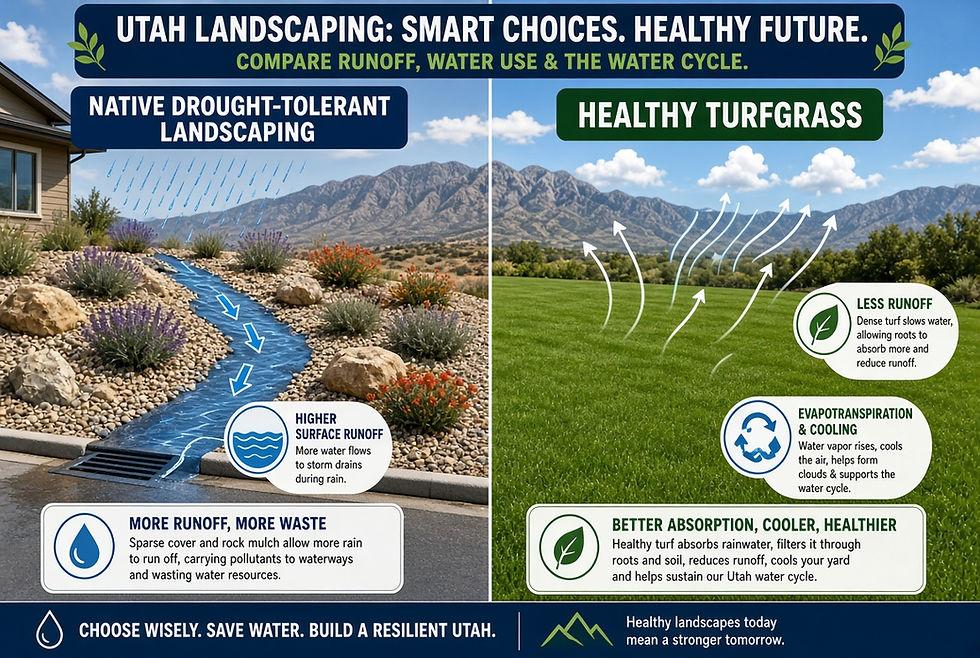
It cools the neighborhood. Living grass measurably lowers surface and near-surface air temperature compared to pavement or bare ground. In a dense urban environment surrounded by asphalt, concrete, and rooftops, grass is one of the only things actively fighting the heat island effect instead of contributing to it.
It recycles water. Grass recycles water back to the atmosphere in a process called evapotranspiration. This process recycles water many times per growing season increasing the chance of presipitation in our local environment. Water allowed to enter quifers and or terminal lakes slows down the cycling effect and benefits the water provides.
It protects people. A grass strip is a soft landing compared to rock or concrete — a real, everyday safety benefit for kids on bikes, pets, and anyone who trips or falls. Remove the grass and that surface becomes harder and more dangerous, permanently.
It holds the ground together and cleans the water that hits it. Grass root systems sequester carbon, prevent erosion, and slow runoff so water has time to filter impurities into the soil instead of sheeting off pavement straight into storm drains, carrying pollutants with it.
It supports mental health. This isn't a soft claim — a meta-analysis of 18 studies covering more than 3.1 million people found a 10% increase in nearby green space is associated with a 3-3.7% reduction in depression risk. Removing grass measurably removes part of that protective effect.
It gives people a reason to move. Mowing and yard upkeep is one of the most common ways people build regular physical activity into their week — a benefit that disappears entirely once the grass, and the maintenance it invites, is gone.
Removing urban grass does not pause these functions — it ends them. And in the most common replacement scenario, it doesn't just remove a benefit, it actively makes the underlying problem of heat and cycling loss worse: rebate-program rules typically require only 25-50% living plant coverage at maturity, meaning half to three-quarters of a "converted" yard can legally end up as gravel or rock — landscaping that runs roughly 7°F hotter at the surface than the grass it replaced. That is not a neutral trade. It is cooling infrastructure removed from a city that needs it, replaced by a surface that adds to the very heat problem the city is trying to solve.
Removal is not a reset button. It is a permanent loss of function, in exchange for a water savings that better watering practices and managed dormancy already deliver without giving anything up.
The waste being targeted is a watering problem, not a grass problem
Most of what's actually visible and frustrating about urban lawn water use — overspray hitting pavement, sprinklers running during rain, daily shallow watering that never reaches the roots — has nothing to do with whether grass is present. It's a scheduling and equipment problem. A lawn watered correctly uses a small fraction of what a poorly managed one does, and the difference has nothing to do with removing the grass itself.
Kentucky bluegrass, which makes up most Utah lawns, needs roughly 1 to 1.5 inches of water per week to stay beautifully green during active growth. Much of the "waste" driving public frustration comes from watering well beyond that — schedules set once and never adjusted, broken sprinkler heads, overspray onto driveways, roads and sidewalks that never reaches a root. Fixing those specific, identifiable problems captures most of the achievable water savings without touching the lawn itself.
Where removal actually falls short
Turf-removal rebate programs are built to replace lawns with native or regionally-adapted plants, which can offer real water savings, but cannot achieve the functions turf provide. The programs' own rules leave enormous room for a worse outcome: municipal turf-removal rebates in the Southwest — Chandler, AZ; the Southern Nevada Water Authority; Albuquerque — commonly require only 25% to 50% living native plant canopy coverage at maturity, with the rest of the converted area allowed to be gravel, river rock, or decomposed granite. Field measurements have found these rock-heavy "xeric" landscapes running roughly 7°-15° F hotter at the surface than a standard lawn. A program operating exactly as designed, with no violations, can legally produce a yard that's majority rock — a real loss in cooling and habitat, this is not a hypothetical worst case as most homeowners lack the drive to install and maintain a native landscape and end up with a zeroscape.
Removal also carries a cost that watering fixes don't: it's expensive, slow, and permanent. Converting a lawn to xeriscape means a redesign, new plants, an irrigation retrofit, an upfront cost that can run into the thousands of dollars, and one to two years of establishment care before the new landscape matches the coverage of the lawn it replaced with no chance of achieving the functions of grass— with real risk of failure if that care lapses. None of that is required to fix overspray, bad scheduling, or an unmonitored irrigation controller.
The better tool: Managed Dormancy
Kentucky bluegrass has a built-in mechanism for cutting water use dramatically without removal: when water becomes scarce, it goes dormant rather than dying. The blades brown and stop growing, but the crown and root system survive underground, ready to green back up within two to three weeks once regular watering resumes. During Colorado's total irrigation restrictions in the 2002 drought, most bluegrass lawns recovered fully the following year, while tall fescue lawns — which lack a comparable dormancy mechanism — were largely killed and had to be replaced.
A healthy bluegrass lawn can go roughly six weeks with no irrigation at all and remain fully recoverable. Beyond that, light supplemental watering — a quarter to half an inch every two weeks — keeps the root system alive through an extended dry stretch.
The savings are substantial, preserving the benefits and easy to verify. Kentucky bluegrass needs about 1 to 1.5 inches of water per week to stay green. Over a 12-week summer stretch — six weeks with no irrigation, then six weeks of light maintenance watering — a 1,000-square-foot lawn using normal watering would use approximately 9,345 gallons. Under managed dormancy, that same lawn uses approximately 1,620 gallons: a savings of roughly 7,725 gallons, or an 83% cut, while the lawn stays fully recoverable. Scaled up: a 5,000-square-foot lawn saves about 38,600 gallons over that stretch; an 8,000-square-foot lawn saves about 61,800 gallons.
This is also the easiest water-conservation measure to get widespread compliance on, because it asks homeowners to do less, not more. There's no redesign, no new plants, no installation cost, no waiting years for a new landscape to establish — just a different setting on an irrigation controller that's already there.
What this means for policy
The instinct behind targeting urban turf is an understandable knee jerk reaction — it's the most visible category of residential water use, and it's the one homeowners have the most direct ability to change. But the actual fix should match the actual problem: fixing overspray, correcting watering schedules, and promoting managed dormancy during drought years accomplish the same or better water savings the state is after, without the cost, delay, and environmental tradeoffs of removal.
Urban water savings is not accomplished by removing grass. It's accomplished by watering it correctly. Urban Water Savings Isn't Accomplished by Removing Grass... Managed Dormancy


Comments