


Data Centers Are Creating Local Heat Islands — And It’s Affecting Our Weather and Water Cycle
Data Centers Are Creating Local Heat Islands — And It’s Affecting Our Weather and Water Cycle
As Utah and the American West battle drought and water challenges, a new source of localized warming is quietly growing: data centers. These massive facilities powering AI, cloud computing, and the digital economy are generating enormous amounts of waste heat — and the impacts are more significant than most people realize. Data Centers Are Creating Local Heat Islands — And It’s Affecting Our Weather and Water Cycle

How Much Heat Are We Talking About?
Data centers convert nearly 100% of the electricity they consume into heat. A single large campus can produce waste heat equivalent to that of tens of thousands of homes running constantly. With the AI boom, data center electricity demand is projected to double or triple by 2030. Cooling systems alone can account for 30–40% of their total energy use.
The Rise of “Data Heat Islands”
Recent studies using NASA satellite data confirm that data centers create noticeable localized heat islands:
Average surface temperature increase: 2–3.6°F (1–2°C) after a facility opens.
In some cases: up to 9–16°F (5–9°C) hotter.
The warming effect can extend several kilometers downwind, impacting nearby neighborhoods, farms, and ecosystems.
This added heat raises nighttime temperatures, increases cooling demand for homes and businesses, and intensifies summer heat stress.
How This Affects Condensation and the Water Cycle
Higher temperatures from data centers have a direct negative impact on local moisture dynamics:
Reduced Relative Humidity: Warmer air holds more moisture before it reaches saturation. This makes condensation (dew, fog, and cloud formation) less likely.
Suppressed Dew and Fog: Nighttime warming prevents temperatures from dropping to the dew point, reducing natural moisture recycling.
Altered Precipitation Patterns: The extra heat can change local wind patterns and convection, sometimes leading to more intense but less frequent rain events — or overall drier conditions in arid regions.
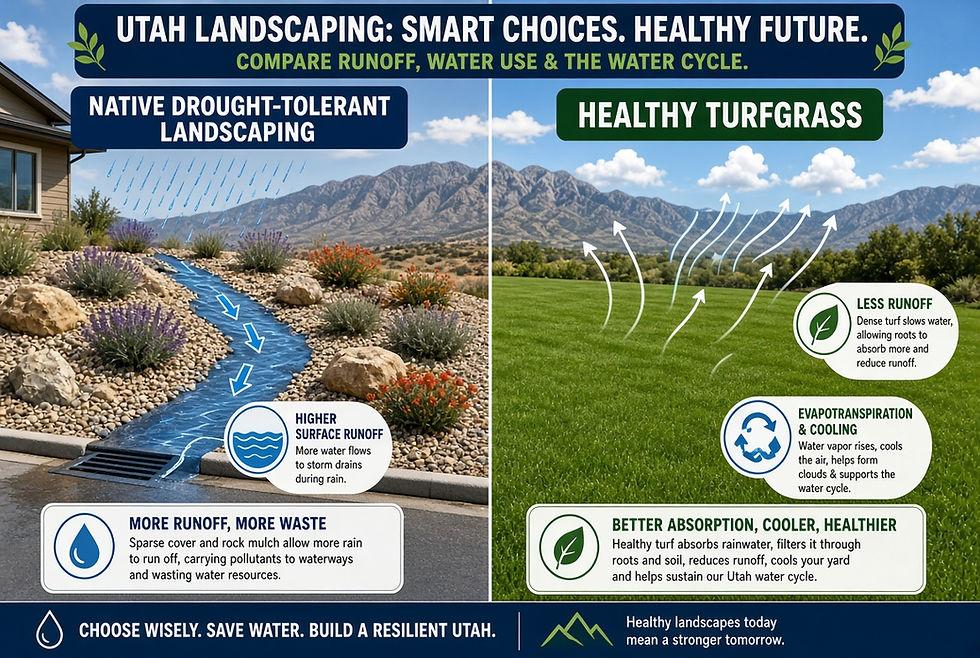
Disrupted Small Water Cycle: Unlike healthy grass and vegetation, which cool the air while adding moisture through evapotranspiration, data center heat tends to dry out the local atmosphere and weaken the rapid moisture recycling that supports precipitation.
In short, data centers work against the natural processes that grass and living landscapes enhance.
Natural Grass vs. Data Center Heat
Factor | Healthy Grass & Vegetation | Data Center Heat Island |
Temperature | Cools air by 3–15°F | Warms air/surfaces by 2–16°F |
Relative Humidity | Increases (adds moisture) | Generally decreases |
Condensation & Clouds | Promotes dew, fog, and rain | Suppresses condensation |
Water Cycle | Accelerates recycling (“Grow the Flow”) | Disrupts rapid moisture recycling |
Why This Matters for Utah
As we push for policies that support well-managed natural grass, composting, and soil health to strengthen our water cycle, we must also be aware of new sources of localized warming and drying. Data centers are essential for our digital economy, but their unchecked heat output can counteract the environmental benefits of vegetation and make drought conditions feel worse at the local level.
The solution isn’t to stop progress — it’s to demand smarter siting, better cooling technologies (like waste heat recovery), and stronger protection of natural landscapes that actively cool and hydrate our environment.
Healthy grass isn’t just nice to look at — it’s a powerful counterbalance to the heat islands we’re creating. By maintaining and expanding well-managed vegetation, we can help restore balance: cooler neighborhoods, better moisture recycling, and more reliable local precipitation.
What do you think? Should we be more thoughtful about where data centers are built and how they interact with our natural landscapes?
Share your thoughts below.


Comments