


"Nonfunctional Turf": A Label That Undermines What Grass Actually Does
"Nonfunctional Turf": A Label That Undermines What Grass Actually Does
Utah, Nevada, and California have all passed or proposed laws targeting what water agencies call "nonfunctional turf" — grass in medians, park strips, and HOA common areas that isn't used for recreation. The policy goal is commendable. The idea that outdoor irrigation eats up, destroyes or depletes the majority of residential water in arid Western cities, and the Great Salt Lake and Colorado River Basin are flawed at best. But the term itself, and the way grass-removal programs actually play out, deserve closer scrutiny than they usually get — and grass deserves a fairer hearing than it's been getting.
A quick note on language: "turf" was always the term for real, living grass — it's the older, correct word for a natural grass-covered surface. Plastic-and-rubber "artificial turf" is the newcomer, "borrowing" a name that never belonged to it. Letting the synthetic product commandeer the word "TURF" does an actual disservice to the real thing: living grass gets stuck defending itself against associations — fake, low-maintenance, disposable — that belong to the plastic product, not to it. This piece uses "grass" and "lawn" for the real plant, to keep that distinction clear.

The word "nonfunctional" does more than it says
Legal language, "nonfunctional grass" is a narrow category — grass no one supposedly walks on except to mow it. Residential lawns, sports fields, and parks are typically exempt. But that exemption gets lost the moment the phrase hits a news headline or a rebate mailer. Most people don't read the statute; they absorb the negative connotation. And the connotation is "grass = waste." That framing quietly extends a narrow, defensible policy target into a broader message that grass in general has no value — which isn't what the legal definition says, but is very much how it is percieved.
Grass is doing far more than it gets credit for
Calling a park strip "nonfunctional" because no one plays soccer on it skips past everything that grass is actively contributing while it sits there:
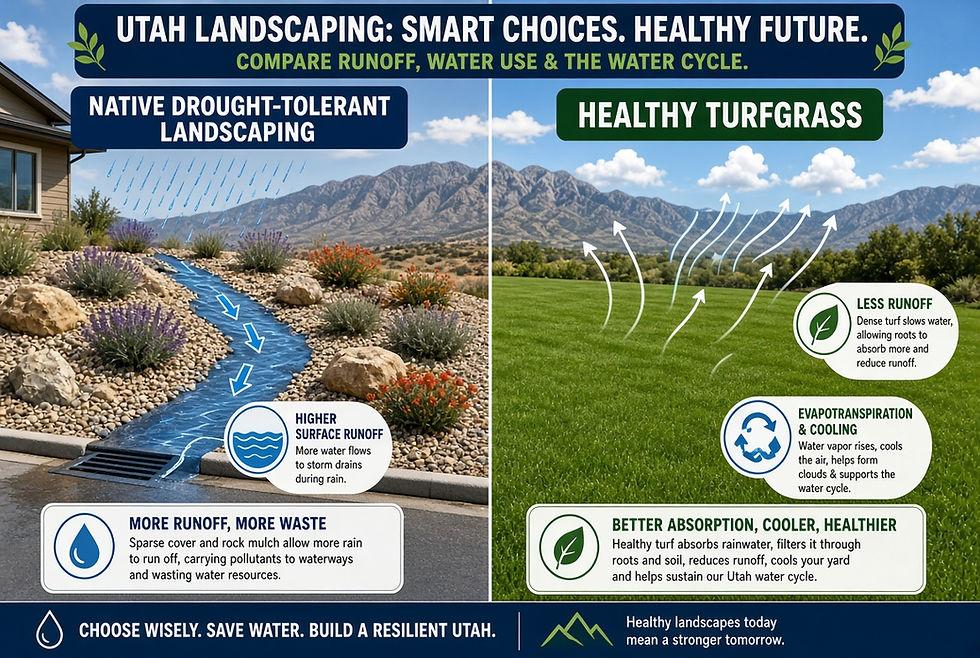
Cooling — living grass measurably lowers surface and near-surface air temperature compared to pavement or bare ground, softening the urban heat island effect and making neighborhoods more livable in summer. That COOLING is vital for Condensation.
Cushioning and safety — a grass strip is a soft landing compared to jagged rock or concrete, a genuine, everyday safety benefit for kids on bikes, pets, and anyone who trips or falls.
Carbon capture and soil health — grass root systems sequester carbon and hold soil in place year-round, working quietly in the background regardless of whether anyone's picnicking on it.
Oxygen production — Grass is bu far the best producer of Oxygen, 2500 Sq Ft of Grass immiediatly starts producing oxygen while trees take years to mature to full production. Do trees ever catch up? 80% of the earths landmass is covered by grass for a reason.
Mental health — this isn't a vague "green is nice" claim. A meta-analysis of 18 observational studies covering more than 3.1 million people found that a 10% increase in green space near residential areas is associated with roughly a 3-3.7% reduction in depression risk. Removing grass measurably removes some of that protective effect, not just curb appeal.
Exercise — mowing and yard upkeep is one of the most common ways people build regular physical activity into their week, a benefit that vanishes once the grass — and the maintenance it invites — is gone.
Grass isn't a passive, empty space waiting to be justified. It's quietly doing real work — cooling, holding soil, capturing carbon, producing oxygen, softening falls, lifting moods — every single day it's alive, whether or not it's "used" in the narrow sense regulators are measuring.
The real policy problem is category, not grass
A more precise policy would regulate by ability to water properly — a square-footage cap on irrigated lawn area — rather than by watering ability as a category. That targets genuinely excessive water use directly, without implicitly branding all grass as the problem. Right now, the messaging conflates "this specific lawn is larger than it needs to be" with "grass is the issue," and that's an intentional framing choice, not a scientific necessity.
Grass-removal programs produce worse outcomes than intended
The stated goal of most rebate programs is to swap high-water lawns for native or regionally-adapted plants, which can keep much of the cooling, carbon, and habitat value at a lower water cost. In practice, the programs' own rules show how much room they leave for a rock-heavy outcome: municipal turf-removal rebates in the Southwest — Chandler, AZ; the Southern Nevada Water Authority; Albuquerque — commonly require only 25% to 50% living plant canopy coverage at maturity, with the remaining half to three-quarters of the converted area allowed to be inorganic groundcover: gravel, river rock, or decomposed granite. A California-focused analysis of these programs found real water savings, but noted that the studies "do not take into account the surface temperatureor other benefits grass provides in the surrounding area" — and separate field measurements cited in that same analysis found xeric (rock-heavy, sparse-plant) landscapes ran about 17°F hotter at the surface than a standard turf lawn. So even a program operating exactly as designed, with no cheating or under-planting, can legally produce a yard that's majority rock — a real net loss on cooling and habitat, not a hypothetical worst case.
Even where native plants do go in, they come with their own maintenance reality that rarely makes it into the pitch: native landscaping tends to look its best in the first year or two, right after installation, and can decline from there without consistent upkeep — irrigation calibration, weeding, pruning, replacing plants that don't establish. A well-kept lawn, by contrast, is comparatively low-skill to maintain in a recognizable, tidy state year after year: mow, water, done. The "just switch to natives, it's easier" pitch understates how much ongoing attention a native landscape actually needs to stay looking better than the grass it replaced, rather than worse.
Grass also slows water down and puts it back to work faster
There's another role grass plays that rarely comes up in the water-use conversation: what it does to water before that water ever reaches an aquifer, a drainage system, or a lake.
A grass surface slows the flow of water across the ground and cleans it of chemicals and debris. more importantly instead of rain or irrigation sheeting off a hard or bare surface and rushing straight into storm drains, grass and its root mass act like a brake and a pump — slowing runoff, giving water time to soak into the soil, and letting grass roots take some of it up, pumping it back into the atmosphere for rain and cooling rather than losing it all to drainage. Water that a plant's roots draw up gets used and recycled through the plant multiple times over a single growing season, cycling through soil, plant, and atmosphere repeatedly rather than making a single one-way trip to a terminal lake or drainage.
The actual numbers back this up. Research from NASA's Goddard Space Flight Center on the global fresh water cycle puts average residence times for grass at 3 days roughly 10 days for water in the atmosphere, about one week for water held in plants and other living things (the "biological" reservoir), and about two months for water sitting in soil moisture — with lakes and aquifers far more variable, ranging from weeks up to many years. Compare that to where water goes once it drops out of that fast surface cycle: aquifers commonly hold water for centuries, with some deep or "fossil" groundwater dating back tens of thousands to hundreds of thousands of years, and the ocean holds the average water molecule for roughly 3,000 years before it cycles back through the atmosphere.
Lined up, the contrast is stark:
Grass: ~3 days
Atmosphere: ~10 days
Plants / biological uptake (grass roots included): ~1 week
Soil moisture: ~2 months
Lakes: weeks to (in some cases) centuries
Aquifers/groundwater: commonly centuries; some deep groundwater tens of thousands to hundreds of thousands of years
Ocean: roughly 3,000 years on average
Grass sits at the fast end of that spectrum — pulling water up and releasing all of it back to the atmosphere on a timescale of days to weeks, over and over across a growing season. Once that same water bypasses the root zone and moves into an aquifer or a terminal lake, it can be locked up for years, centuries, or longer before it re-enters the active part of the cycle. That's a real, measurable difference in how many times a gallon of water gets reused within a single year — and it's part of the water cycle that gets erased when the conversation reduces to "grass wastes water," or "Non-Functional Grrass."
Kentucky bluegrass's built-in water-saving trick: Dormancy
Most of the grass in Utah lawns is Kentucky bluegrass, and it has a survival mechanism that rarely makes it into the water-conservation conversation: when water gets scarce, it goes dormant rather than dying. The blades brown and stop growing, but the crown and root/rhizome system stay alive underground, waiting out the dry spell. This isn't a minor detail — it's the reason Kentucky bluegrass fared so much better than other common lawn grasses during Colorado's total irrigation ban in the 2002 drought. Most Kentucky bluegrass lawns recovered completely once watering resumed the following year, while tall fescue lawns, which lack much of a dormancy mechanism, were largely killed and had to be reseeded or resodded.
The real-world guidance on how far this can be pushed: a healthy Kentucky bluegrass lawn can typically go a good six weeks with no water at all and remain fully recoverable. Beyond that, a light supplemental watering — roughly a quarter to a half inches every two weeks — is generally recommended to keep the crown hydrated enough to survive and bounce back, rather than continuing on zero water indefinitely. Under the right conditions, Kentucky bluegrass has gone an entire season dormant on essentially no irrigation and still recovered the following year. Once regular watering returns, it typically greens back up within two to three weeks.
That's a meaningfully different water-conservation strategy than removal: instead of tearing out grass and losing its cooling, carbon capture, oxygen production, root structure, and runoff control permanently, a "reduced water, allow dormancy" approach can cut irrigation dramatically — for months at a stretch — while keeping the root system, and everything it does for the soil and the water cycle, alive and ready to resume the moment water becomes available again. It's worth being honest about the trade-off: a dormant lawn is brown, and it pauses its cooling and evapotranspiration benefits while it's shut down, rather than providing them continuously. But "paused for a season, then fully restored" is a very different outcome than "removed and gone," and it's a strategy conservation campaigns could promote far more directly than they currently do.
Here are the numbers. Kentucky bluegrass needs 1 to 1.5 inches of water per week to stay green (median: 1.25 in/week). During dormancy, extension guidance for keeping the crown alive ranges from ¼ inch to 1.5 inches every two weeks (median: 0.875 in every 2 weeks, or 0.44 in/week). One inch of water over 1,000 square feet is about 623 gallons. Run that through a 12-week summer stretch — six weeks with zero water, then six weeks of light maintenance watering — on a 1,000 square foot lawn:
Normal watering | Dormancy strategy | |
Weeks 1–6 | 7.5 in | 0 in |
Weeks 7–12 | 7.5 in | 2.6 in |
Total water | 15 in | 2.6 in |
Gallons per 1,000 sq ft | 9,345 gal | 1,620 gal |
That's a savings of 7,725 gallons per 1,000 square feet over 12 weeks — an 83% cut in water use. Scaled up: a 5,000 square foot lawn saves about 38,600 gallons; an 8,000 square foot lawn saves about 61,800 gallons. That's over three-quarters of a summer's irrigation water saved, on a lawn that greens back up in two to three weeks once normal watering resumes and keeps every long-term structural, cooling, and soil benefit it provides intact the whole time.
Legislators do not need to remove grass to hit water-reduction targets. They need to promote managed dormancy. The savings are already there, without the tradeoffs that come with removal.
There's also a practical advantage here that removal can't match: dormancy is something a homeowner can do this week, with equipment they already own. Converting a lawn to xeriscape means a redesign, new plants, a retrofitted irrigation system, an upfront cost that can run into thousands of dollars, and one to two years of establishment care before the new landscape looks as good as the lawn it replaced — with real risk of failure if that care lapses. Managed dormancy means walking out to the irrigation controller and setting it to run once a week instead of two or three times, or turning it off entirely for six weeks. No redesign, no new plants, no installation cost, no waiting years to see the payoff — just a different setting on a system that's already installed. That's a policy easier to get widespread compliance on than any removal program, because it asks homeowners to do less, not more.
Where the water actually goes matters more than slogans
It's worth being precise here too: in arid interior climates like Utah's, most incoming precipitation is imported moisture from the Pacific and Gulf of California. During the Summer months grass helps water locally recycle back into rain by evapotranspiration. Removal of grass does reduce local cooling and humidity contribution, in a system where local vegetation cover has already been declining for decades due to construction and development — a trend worth watching in its own right, separate from any single grass policy.
The bottom line
Reducing water waste on application in the arid West is a legitimate and urgent goal. But grass — including the Kentucky bluegrass that makes up most Utah lawns — isn't the obstacle to that goal. It cools neighborhoods, holds soil, produces oxygen, captures carbon, cushions falls, slows runoff into the ground, and cycles water back to the atmosphere faster than almost anything that would replace it. It can also survive on a fraction of its usual water through dormancy and come back fully once conditions improve — a tool for cutting water use dramatically without giving any of those benefits up for good. Weighed against the alternative — permanent removal, too often ending in gravel — grass's benefits hold up as the better bet for the local environment. The problem was never grass. It was always how it's watered.


Comments