


How to Save Water and Still Keep a Healthy, Green Lawn
How to Save Water and Still Keep a Healthy, Green Lawn Practical Utah strategies that cut water use without giving up living grass
You don’t have to rip out the lawn to use less water. Living grass recycles water through photosynthesis and the water cycle, cools the yard, and gives your family a place to play. The goal is to support those benefits with far less waste.
Here’s how to Save Water and Still Keep a Healthy, Green Lawn.

Grass does not deplete water — it recycles it
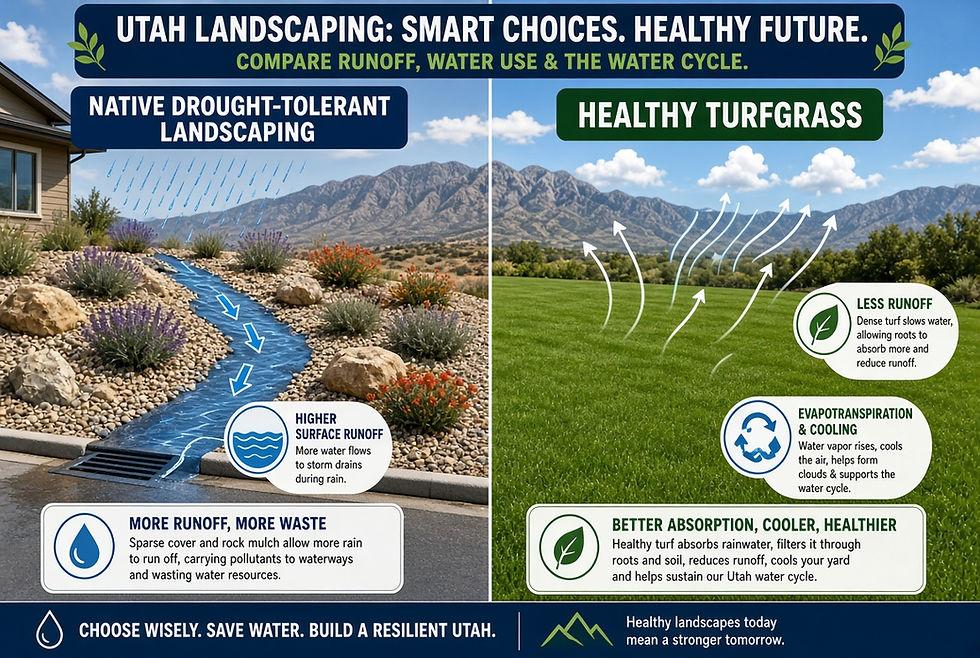
Through photosynthesis, grass uses water and carbon dioxide to build sugars and release oxygen. Most of the water a lawn “uses” is drawn up from the soil and released back into the air as vapor through the leaves (transpiration). That moisture joins the local atmosphere and can later return as rain.
Water that soaks in and is not taken up by the roots doesn’t simply disappear either. A good share can percolate deeper and help recharge groundwater and aquifers — especially when living turf slows runoff and improves infiltration compared with rock or pavement.
Efficient irrigation still matters. The point is to keep the living cover that performs these functions while wasting less.
How much water does a Utah lawn actually need?
Most Kentucky bluegrass lawns need roughly 1 to 1.5 inches of water per week during active growth, including rainfall. One inch over 1,000 square feet is about 623 gallons.
Most overwatering isn’t from watering too many days — it’s from applying more than the lawn can use, so excess runs off into the street or evaporates before it reaches the roots.
Practical ways to know when (and how much) to water
Tuna-can method Place several straight-sided cans around the lawn, run the sprinklers for a set time, and measure the water in each can. That tells you how many minutes your system needs to deliver ½ inch or 1 inch — and shows uneven coverage.
Screwdriver / probe method Push a long screwdriver into the soil. If it slides in easily to 4–6 inches, the root zone is still moist. If it meets hard resistance after an inch or two, it’s time to water.
Color and footprint method A bluish-gray or dull cast, footprints that stay visible, or leaves that fold or roll are early drought signals. Water when you see these signs rather than only on a rigid calendar.
Rain adjustment After a measurable rain, skip or reduce the next cycle. A cheap rain gauge (or the same cans left out during a storm) shows how much nature already supplied.
Water smarter, not more
These changes cost nothing and often cut use 20–30%:
Water early morning (4–9 a.m.)
Water deeply and infrequently (2–3 times per week) instead of daily and shallow
Use cycle-and-soak on slopes or compacted soil
Fix overspray onto sidewalks and driveways
Add a rain sensor or smart controller if you don’t have one
Mowing and soil habits that save water
Mow at 3–3.5 inches — taller grass shades the soil and reduces evaporation
Never remove more than one-third of the blade at once
Keep the mower blade sharp and leave clippings on the lawn
Aerate once a year and topdress with compost so the soil holds water better
Managed dormancy: the biggest cut most homeowners never try
Kentucky bluegrass can go dormant in heat and drought instead of dying. The blades turn brown, but the crowns and roots survive and typically green up in two to three weeks once regular watering resumes.
A healthy stand can often go about six weeks with little or no irrigation and remain fully recoverable. Over a 12-week summer stretch, that approach can cut water use by roughly 80% compared with keeping the lawn green the entire time.
The trade-off is a brown lawn for a while. A lawn that goes dormant and recovers is still very different from a lawn that is removed and gone.
Quick checklist
Target 1–1.5 inches per week total (including rain) in active growth
Measure output with tuna cans; check moisture with a screwdriver
Watch color and footprints for early stress
Water early, deeply, and less often
Mow high, aerate, and improve soil with compost
Consider managed dormancy during the hottest stretch
Remember: grass drives photosynthesis and recycles water; unused water can help recharge aquifers
Bottom line
Keep the lawn. Water it intelligently. Use simple field methods so you apply only what is needed. Living grass continues to cool, cycle moisture, and give you usable outdoor space — while you use far less water than a rigid, wasteful schedule.


Comments