


Mow for More: Why Your Lawn and Regular Mowing Deliver Real Environmental Wins—While Xeriscaping and Plastic Grass Come at a Hidden Cost Step barefoot onto a freshly mowed lawn on a hot summer day in
While Xeriscaping and Plastic Grass Come at a Hidden Cost
Step barefoot onto a freshly mowed lawn on a hot summer day in Utah. The grass is cool, springy, and alive under your feet. Now imagine the same afternoon on rock-covered xeriscaping or plastic artificial turf—the surface radiates heat like a parking lot. That difference isn’t just comfort. It reflects measurable impacts on temperature, air quality, water cycling, soil health, exercise, human health, and safety—and long-term environmental resilience. Xeriscaping and Plastic Grass Come at a Hidden Cost

Natural grass lawns, properly maintained through regular mowing, provide a suite of ecosystem services that hardscape-heavy xeriscaping and synthetic turf cannot replicate—and often actively degrade. In arid regions like Utah, where water policy and heat management matter deeply, understanding these trade-offs is essential.
Lawns as Nature’s Air Conditioners: The Cooling Power of Evapotranspiration

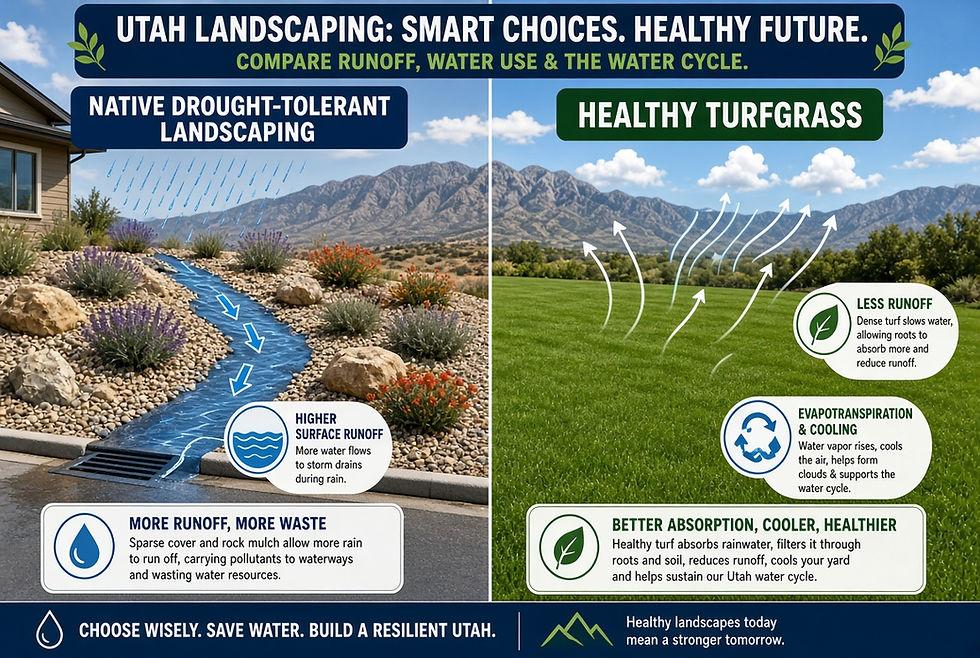
Healthy turfgrass cools its surroundings dramatically through evapotranspiration (ET)—plants absorb water through roots and release it as vapor through leaves, absorbing heat in the process.
Lawns can run 10–14°F cooler than concrete or bare soil and 30–60°F cooler than asphalt or pavement on hot days.
A typical front lawn provides cooling roughly equivalent to 9 tons of air conditioning.
Natural grass surfaces are often 40–100°F cooler than synthetic turf on peak summer days.
This cooling reduces urban heat island effects, lowers indoor air conditioning demand, and makes outdoor spaces usable (and safer). Regular mowing keeps grass dense and actively growing, maximizing leaf surface area for ET and preventing the thin, stressed patches that reduce cooling performance. Proper mowing heights (often around 2 inches for many cool-season grasses) promote deeper roots and thicker cover, optimizing the cooling effect.
Oxygen Production, Air Quality, and Carbon Benefits
Through photosynthesis, grass absorbs CO₂ and releases oxygen.
Just 25 square feet of healthy lawn produces enough oxygen for one adult per day.
A 5,000 sq ft lawn can supply oxygen for 14–34 people daily.
An acre of turf produces enough oxygen for about 64 people per day—often outperforming trees on a per-acre basis during peak growth.
Lawns also filter dust, pollen, smoke, and pollutants from the air. Regular mowing maintains vegetative (non-flowering) growth, which can help manage certain allergens compared to unmowed or weedy areas, while clippings returned to the lawn recycle nutrients and support soil microbes.
Lawns sequester carbon in soil and biomass—hundreds to over a thousand pounds per acre annually in well-managed systems—and contribute significantly to landscape-level carbon capture.
Water Cycling, Filtration, and Soil Protection
In Utah’s arid climate, turf plays an active role in the local water cycle. Transpiration returns substantial moisture to the atmosphere (an acre can release thousands of gallons daily in summer), recycling water locally rather than losing it entirely to runoff or deep drainage.
Established lawns excel at:
Slowing stormwater and reducing flooding
Filtering pollutants before they reach waterways
Preventing wind and water erosion through dense root systems and surface cover
Recharging groundwater more effectively than bare soil or impervious surfaces
Mowing is essential here too. It stimulates lateral growth and root development, creating the dense sod that maximizes these protective functions. Proper mowing also allows clippings to act as natural mulch, returning nitrogen, phosphorus, and potassium to the soil and reducing the need for synthetic fertilizers.
Exercise, Health, and Safety: The Human Dimension of Natural Lawns
Beyond environmental services, natural lawns and the routine of mowing deliver direct benefits to physical and mental well-being.
Exercise: Mowing the lawn is legitimate moderate-to-vigorous physical activity. Pushing a mower (especially a walking or self-propelled model) engages core, arms, and legs, providing cardiovascular exercise, calorie burn, and strength building similar to a brisk walk or light workout. Regular lawn care encourages time outdoors and movement—far healthier than sedentary alternatives or the minimal upkeep of synthetic surfaces.
Health:
Mental health: Views of and time in green spaces reduce stress, anxiety, and depression while improving mood and cognitive function. Hospital patients with grass/landscape views recover faster.
Physical health: Cleaner air from pollutant filtration and oxygen production, combined with the cooling effect, makes outdoor activity more comfortable and frequent. The carbon sequestration and overall ecosystem services contribute to broader community health by mitigating heat-related illnesses.
Regular mowing keeps the lawn healthy, maximizing these benefits and supporting an active lifestyle.
Safety:
Temperature safety: Natural grass stays dramatically cooler, reducing burn risks to bare feet, children, pets, or athletes—unlike artificial turf that can exceed 150°F.
Injury reduction: Grass provides natural cushioning and better traction than rocks/gravel (trip hazards) or hard synthetic surfaces (higher impact on joints).
Chemical and particulate safety: No leaching of PFAS, heavy metals, or microplastics common in artificial turf. Lower risk of skin irritation, ingestion, or long-term exposure compared to synthetics or dusty rock yards.
Mowing safety practices (proper equipment, protective gear, clear debris) are straightforward and promote overall yard maintenance that keeps play areas hazard-free.
These human-centered benefits make natural lawns superior for families, especially in high-use residential or recreational settings.
The Real Costs of Xeriscaping (Especially Rock-Heavy “Zeroscaping”)
Water-wise landscaping has value when done thoughtfully—with appropriate plants, mulch, and efficient irrigation. However, many conversions replace turf with rocks, gravel, and minimal vegetation. These often increase problems:
Heat amplification: Rocks and gravel absorb and radiate heat, worsening urban heat islands. Neighborhoods become hotter and drier, increasing water stress on remaining plants and potentially raising cooling costs and heat-related health risks. Utah water resources officials have warned that such landscapes can “backfire” by cranking up heat and evaporation rates elsewhere.
Reduced ecosystem services: Less vegetation means less cooling via ET, less oxygen production, less carbon sequestration, and weaker natural filtration—plus more potential safety issues from uneven rocky surfaces.
Water quality impacts: Recent turf-to-xeriscape conversions frequently show higher sediment (TSS) runoff and elevated nitrate leaching initially, as disturbed soil lacks roots to stabilize it and plants to uptake nutrients. These effects can persist for years before declining.
While mature, plant-rich xeriscapes improve over time, blanket removal of functional turf often trades one set of issues for another—especially hotter, less livable, and potentially less safe outdoor spaces.

Utah Landscaping FAQs: Answers to Your Most Common Questions - Utah Valley Landscaping
The Hidden Harms of Plastic (Artificial) Grass
Synthetic turf is marketed as low-maintenance and water-saving, but the environmental and health ledger tells a different story:
Extreme heat: Surfaces routinely reach 110–150°F+ (far hotter than natural grass). One study at BYU recorded synthetic fields averaging ~117°F versus ~78°F on natural turf. This intensifies heat islands, produces dangerously hot stormwater runoff, and creates serious burn/safety risks.
Microplastics pollution: Fibers and infill (often crumb rubber) break down and shed hundreds to thousands of pounds of microplastics per field annually into soil, waterways, and air. Microplastics are now found in human blood, lungs, and elsewhere; regulatory pressure is growing.
Chemical contamination: Many systems contain or leach PFAS (“forever chemicals”), heavy metals (zinc, etc.), PAHs, and other toxins from tire-derived infill. These can migrate into groundwater and stormwater, posing risks to ecosystems and potentially human health (including heightened exposure for children and pets playing on it).
Zero net ecosystem benefit + safety drawbacks: No meaningful ET cooling, no oxygen production, no soil building, no carbon sequestration (and often a negative lifecycle footprint from production and disposal). Higher injury potential due to hardness and heat.
For pets, children, and athletes, the combination of extreme surface heat, chemical exposure, and microplastics adds unnecessary risks—making it far less safe than natural turf.

Heat Levels — Safe Healthy Playing Fields safehealthyplayingfields.org
A Balanced Path Forward for Utah and Beyond
Natural lawns, mowed thoughtfully with efficient irrigation (smart controllers, proper scheduling, drought-tolerant varieties where appropriate), offer the best of both worlds: beauty, function, ecosystem services, exercise opportunities, health improvements, and safety.
Use turf in high-traffic, recreational, or cooling-priority areas.
Incorporate water-wise principles: right plant (or grass) right place, mulch, efficient systems.
Mow high and often enough to keep it thriving—not scalping.
Healthy, mowed lawns deliver cooling, cleaner air, better water management, physical activity, mental and physical health support, safer play surfaces, and livable outdoor spaces that hard alternatives simply don’t. The science on evapotranspiration, urban heat, microplastics, runoff, and human well-being supports keeping—and caring for—natural grass where it makes sense.
Green up. Cool down. Mow on—for your health, your family’s safety, and the planet’s. Your lawn is working harder than most people realize. allamericansod.com


Comments